Group Cases
In addition to Standard Cases, PHDwin offers a series of Group Cases, which aggregate data from specific cases within the database. Group Cases are referred to as the Parent Cases, while their children, or standard cases, are considered to be the individual cases that are compiled to make up the group. By definition, Group Cases are synonymous with the term Ring-Fence, which historically encompassed a group of wells whose production is being accounted for as a group for taxation purposes or investment spending, to name a couple examples. Therefore, they are useful when dealing with cases that have similar properties or are associated with each other in some way.Group Cases are very powerful for defining and managing relationships between individual cases. Changes in production, prices, and expenses could impact the overall economics for the group, so users must recompile the group when such changes occur.
When dealing with multiple cases in the same area or reservoir, for example, it is often easier to combine the production and economics of all the cases and treat them as one large case. One of the most powerful features of Group Cases is their ability to automatically solve for a Group Economic Limit (GEL) that can limit the life of the child cases to the maximum profit of the group. GEL cases would be useful for evaluating leases, gas plants, or situations in which there are group expenses and revenues involved.
Before going into the specific kinds of Group Cases that exist in PHDwin, it is important to identify a couple general terms in relation to Group Cases. Group Cases are either Non-Economic or Economic. Simply put, Non-Economic Group Cases serve to analyze production data, instead of focusing on Cash Flow. Economic Group Cases, however, function as a way to calculate cash flow models in ways where a single case would be too limiting. When generating reports on Economic Group Cases, depending on the type of Group Case, users can output summary reports of the parent and child cases to determine the total life, potential profitability, and Group Economic Limit. Economic Group Cases are useful to model the true condition of the field and ensure accuracy in data.
Different Types of Group Cases
Non-Economic Group Cases:
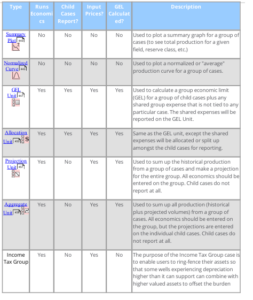
- Summary Plot This is a sum of the production volumes of the child cases. The summary plot is calculated by adding together the production volumes of all the child cases each month and the sums are plotted on the graph. This is useful for grouping all the wells in a certain field or reservoir to view the total production in a single graph. The summary plot does not generate cash flow report, it is excluded from reporting by default, and if an economic report is run on the case, the report displays as non-economic.
- Normalized Curve A Normalized Curve displays the average production volumes of the child cases. The data are normalized based on total wells (well count), lateral length, or proppant mass used. These types of group cases are not very useful for evaluating drilling prospects because it allows the generation of type case based on average production in a field or reservoir, and such type curve can be used as a prospect tool. Normalized curves do not generate cash flow report, it is excluded from reporting by default, and if an economic report is run on the case, the report displays as non-economic.
Economic Group Cases:
- GEL Unit A GEL unit is a GEL Unit is used to calculate the Group Economic Limit (GEL). A GEL unit is created for a group of child cases that must support not only their own expenses, but also the expense of the whole group. The GEL is calculated by grouping child cases that share an expense together and finding the maximum cumulative cash flow, or the date at which the child cases can no longer support the group expense. An example of a GEL Unit would be an offshore platform, where there is a combined expense of running the platform that all the attached wells must contribute to. The expenses are reported at the group case level and not split up by the child cases.
- Allocation Unit An Allocation Unit is similar to a GEL Unit except that the expenses are allocated to the child cases rather than treated as a group expense. The primary Allocation method is based on the relative profits of each case in the Allocation Unit. Allocation Units will still calculate the Group Economic Limit, but expenses will be reported on the individual case level. An example of an Allocation Unit would be an offshore platform, except the expenses are split up to the individual wells based on respective profits.
- Projection Unit A Projection Unit sums together production volumes of child cases and allows the user to build projections at the group level. This type of group case enables the user to treat several cases with similar properties, owners, etc. as one large case. Furthermore, the user can project cases based on a specific field or reservoir. Although the Summary Plot and Projection Unit both sum the production volume of child cases, the Projection Unit allows for economics to be run unlike Summary Plots. Child cases are not reported for the projection unit, only a group level report is generated.
- Aggregate Unit An Aggregate Unit sums together production and projections of child cases. These are useful when unitizing several properties. Economics are reported at the group level rather than individual case level. Child cases are not reported, only a group level report is generated.
- Waterflood Unit A Waterflood Unit is a special case of the projection unit. It sums together production volumes of child cases and allows the user to build projections at the group level. What differentiates a waterflood unit from a projection unit is the phase configuration. A waterflood unit uses the waterflood phase configuration and has two default graph setups to model this type of case.
Summary of Group Cases