Navigation: Graphs > Building Projections on the Graph > Building Stretched Exponential (SEDM) Projections >


 Stretched Exponential (SEDM) Equations
When creating an SEDM projection in PHDwin, the following equations can be used to solve for the initial rate or volumes from the projection given the other variables. The equation listed at the top varies based on the time exponent (n) used in the projection.
Variables qi = Initial Instantaneous Production Rate. Units are [Volume / Time Unit] qt = Instantaneous Rate at time t [Volume / Time Unit] e = mathematical standard = 2.7182818284590452... ln = natural log Np = Cumulative volume produced until time t t = Standard Time in units consistent with the Time Units for q(rate) and d(decline). This should be the cumulative time from the first date of the projection until the date to solve for a variable. The time (t) does not have to be an integer. If decimal values are used, months or years with varying day counts are easily supported. n = Time exponent, dimensionless (no units) τ (tau) = Characteristic time parameter, same unit as time. |
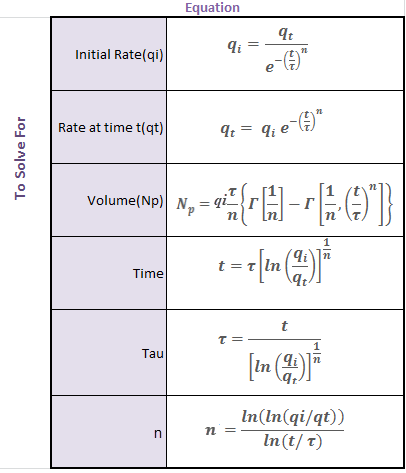
 Calculating "t" (Using Standard Time)
All projection calculations in PHDwin are done using Standard Time which is represented in the formulas as the variable "t". This allows for smooth and continuous reporting of rates and decline across months with non-equal day counts. However, since PHDwin also honors actual day count, a conversion is done to determine the actual time elapsed in standard time. We can assume that:
•Days in a Standard Year = 365.25 •Days in a Standard Month = 30.4375 days •PHDwin Standard month = (Number of days in that month x 12)/365.25 = Number of days in that month /30.4375 oFor example: January = 31 Days/(30.4375 Days in a Std. Month) = 1.01848 Standard Months (slightly more than February, or a month with less days) oFor example: February (on a non-leap year) = 28 Days/(30.4375 Days in a Std. Month) = .91992 Standard Months
|