Navigation: Multi-case Editing > Grid Editor >


The Grid Editor can be used to modify the base expense or expense escalations in a spreadsheet type editor for more than one case at a time.
 To Open the Expenses Table in Grid Editor
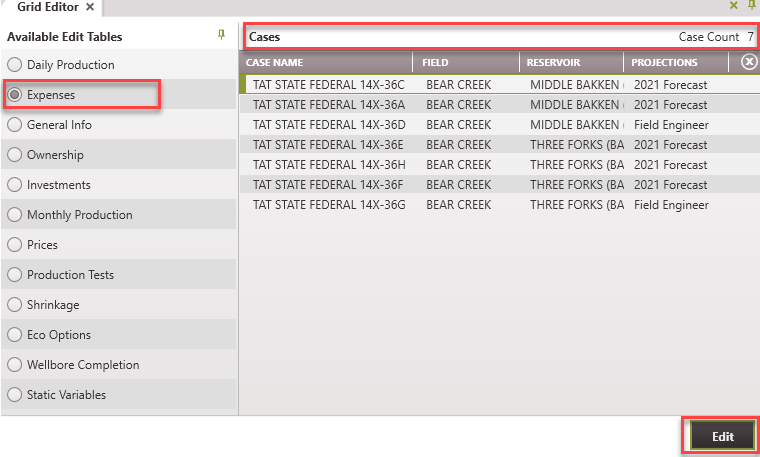
1.Go to the list of Forms and double-click on Grid Editor if it is not already open. 2.Select the cases to edit by dragging and dropping them from the Case List into the right section of the Grid Editor window. Select multiple cases by using Click+Shift, Click+CTRL, or by dragging over a grouping of cases set up in the sort order. The number of cases selected is shown with a case count on the top right. To remove one or more cases, hover over the case and click the 3.Under Available Edit Tables, select Expenses. 4.Click Edit to open the Grid Editor table 5.Make the appropriate changes and click Save to save the data and exit the Grid Editor. |

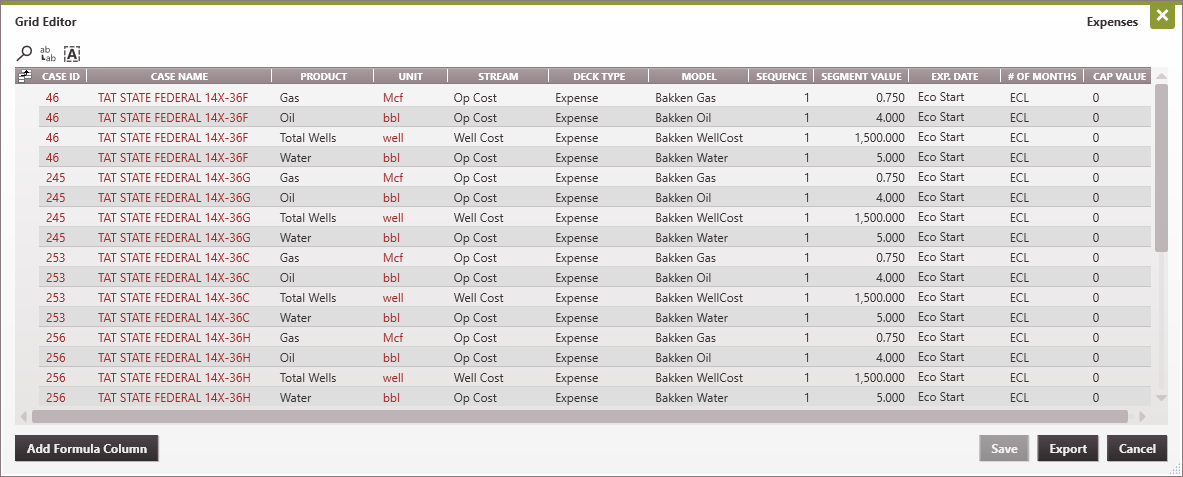
These are the standard columns in the Expenses table. Click on the icon on the top left •Case ID - The ID Code ties each record to a case in PHDwin. New rows should be populated with the proper Case ID. This is a required field when adding new expense records and tells the program which case the expense or expense adjustment will be applied to when the Grid Editor is closed. •Case Name - The Case Name is presented so that users are able to easily identify the case, even though the Case ID is the actual field used by the Grid Editor to link the new expense data to a case. The case name is used for reference and is displayed so users can identify the case being edited. If a new expense record is added, there is no need to populate the Case Name as this new information is not saved in this table. •Product - The product that is associated with the expense. This field is a drop-down menu that contains all the different products to select to modify expenses. The variable costs will be based on products such as Gas or Oil. The product is a required field when adjusting or adding new Expenses lines. The product name has to match one of the available products in the Phase Configuration for the case. If this is not the case, an error occurs and the record will not be pulled back by the Grid Editor. •Unit The units for the expense. For example, for a Gas expense the unit would be $/Mcf. •Stream - The expense stream controls how the expense is netted down and reported.There are several default streams for expense - Op Cost, Trans Cost, Other Cost, Well Cost, and Fixed Cost. Use the drop-down menu to make the appropriate selection. •Deck Type - The deck type will be set to model the base expense or an escalation. The Deck Type will be either - Expense, Percent Escalation, or Add Escalation. •Model - The name of a model that has already been created. A new models cannot be created here. To hard-code an expense, this should be set to Case Specific. The Model column will either say Case Specific or the name of a Model if one was applied to the case, or provide options to apply any existing one to the case. If a model is applied, it cannot be edited in the Grid Editor, so no changes to those values will be saved. •Sequence - Lists which segment of the deck the value is for. The Sequence column lists the order of the segments of a expense deck, if there are multiple segments to model an expense that changes over time. All segments will be listed as their own separate row in the Grid Editor. For a single segment expense deck, the value is 1. For multiple segment expense decks, the value is 1 for the first segment, 2 for the second segment, and so on. •Segment Value - The value of the deck (or the expense, escalation, etc) for the current segment in the units listed. This can be a positive or a negative value. •Exp. Date - The date is only required for the first segment of the deck. It can be populated with a hard-coded or linked date when the expense begins. The length of each segment is set with the # of Months in the next column. Linked dates have to be formatted specifically. Examples of these are in the next section of this topic. In the current build, a date picker (calendar drop-down) is provided to help users enter the date in the correct format. •# of Months - The number of months that the segment lasts. This must be populated for each segment in the deck. To continue until the economic limit, input ECL. For the last value of the segment, this value will automatically be converted to ECL to continue the segment until the economic limit. •Cap Value - The cap value of the expense. The cap value is optional and only applicable to Expense decks (not escalations). The cap must be entered on the first segment of the expense. It will be ignored on all other segments.
|

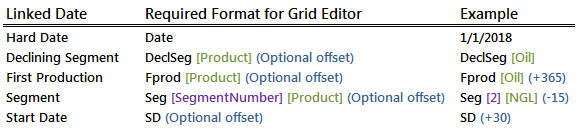
Note: In the latest builds of PHDwin V3 (from build 9), it is now much easier to use linked dates using the provided drop-down menu. This reduces the chances of error. The Link Date field in the Grid Editor must be formatted correctly to avoid getting an error which prevents changes to records from being be saved. Let's say an expense was scheduled to begin, or be linked, to thirty days before the first segment of the case (segments refer to your forecast segments on the graph). Notice that in the Link Date column in the Grid Editor, that value might look something like this: Seg [1] [30]. To add an expense to a handful of cases, it is best to set up a sample for one of the cases on the Expenses form in PHDwin before making the change to the rest of the cases in the Grid Editor, to ensure that the formatting looks right. These are the valid options for Expense linked dates along with examples of how to enter each one in the Grid Editor:
Important notes about linked dates: •The inputs in brackets [ ] are required. •The input in parenthesis ( ) is optional - this is the offset. The (Offset) is a number of days and can be positive or negative. If no offset is entered, zero is assumed, implying no offset. •The offset for Start Date should always be positive. If a negative offset from the case start date is used, it will not report, because nothing is usually reported before the case start date. |